

Is underfloor heating worth it in a London home?
Yes, underfloor heating can be worth it in a London home, but only when the property, insulation level, and project scope suit the system. The real value often comes from better thermal comfort, cleaner use of wall space, and smart zoning, whereas the wrong setup can bring extra cost and disruption without much benefit.
Start With the Unexpected Value of Underfloor Heating in London Homes
Underfloor heating can make excellent sense in London, although it is not automatically the right move for every property.
Many homeowners still associate it with luxury flats or brand-new builds. In practice, the decision usually turns on plainer issues such as floor construction, insulation, room layout, and how much disruption a project can absorb. A compact terrace in North London may benefit more from freeing up radiator space than a larger home with an already effective heating system.
Comfort is also often misunderstood. Radiators heat a room in a familiar way, but underfloor heating changes how warmth is felt across the space. That matters in London homes with awkward furniture layouts, narrow rooms, or open-plan rear extensions where cold patches can be more noticeable.
Upfront cost tends to dominate early thinking. Yet long-term value often sits elsewhere, including more usable wall area, better heating zones, and a system that works quietly in the background if it has been planned well and paired with suitable insulation. Building Regulations, especially Part L, also shape what works well, because heat loss and energy performance affect whether the system will feel effective in daily use.
A surprising point for many homeowners is that underfloor heating is often less about indulgence and more about fit.
Speak with our team to receive a tailored underfloor heating quote that matches your property and renovation goals.
Get Your QuoteAudit Your Property’s Suitability Before Deciding
Some London homes are good candidates for underfloor heating. Others need much closer scrutiny before the idea makes financial or practical sense.
What increases suitability
Modern extensions usually offer the simplest route. New floor build-ups can be designed around insulation, pipework or mats, and finished floor levels from the start. Ground-floor renovations also tend to give more flexibility, especially where old floors are already being lifted.
Well-insulated spaces generally suit underfloor heating better because the system works most effectively when heat is retained rather than lost through the floor, walls, or draughty openings. Open-plan kitchen areas often fall into this category, particularly where glazing, layout, and heating zones have all been considered together.
Room use matters as well. Bathrooms, for instance, often suit electric underfloor heating because the area is smaller and the comfort gain is felt immediately on cold mornings.
What complicates installation
Period homes can be more difficult. Victorian and Edwardian properties across London often have suspended timber floors, uneven subfloors, and tighter tolerances around doors, skirtings, and stair thresholds. Once floor height starts to rise, the knock-on effects spread quickly through the room.
Leasehold flats introduce a different set of questions. Freeholder permissions, neighbour impact, service routes, and communal heating arrangements can all affect what is possible. Listed properties may need extra care as well, particularly where original fabric is involved or local authority planning concerns overlap with heritage guidance.
Access can become the deciding factor. In a narrow London terrace with limited storage and restricted working space, installation disruption has a different weight than it does in a detached home with easier logistics. A property may be technically suitable on paper and still be a poor candidate once real site conditions are taken seriously.
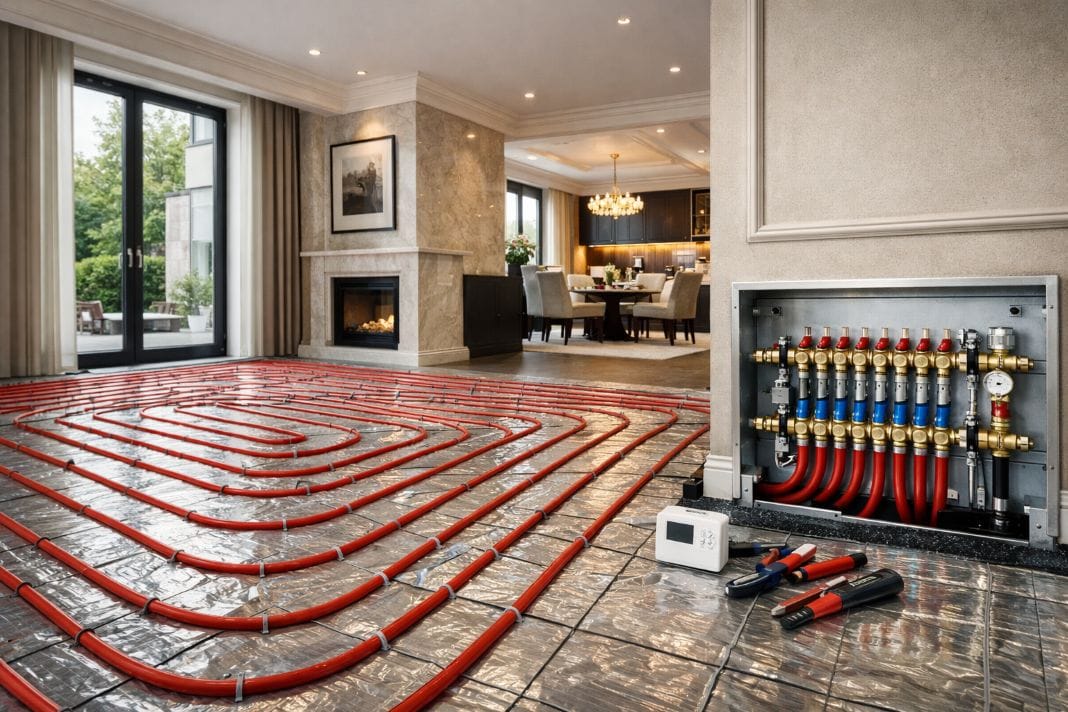
When planning a renovation, coordinate floor build-up and heating zones early to maximise the benefits of underfloor heating.
Compare Wet and Electric Underfloor Heating Systems for London Homes
Picture two projects. One is a Victorian terrace in West London having a single bathroom updated. The other is a rear kitchen extension where the entire ground floor is being rebuilt. Both may suit underfloor heating, but they almost certainly do not suit the same system.
Wet systems, also called hydronic systems, circulate warm water through pipes beneath the floor. They usually make more sense in larger areas or as part of wider renovation work, because installation is more involved and floor build-up needs proper planning. Where floors are already coming up, the extra coordination can be reasonable.
Electric systems use cables or mats beneath the floor finish. They are often easier to install in smaller rooms and in targeted retrofits where homeowners want warmth in a bathroom, en suite, or single converted space without altering the whole heating setup. Disruption is usually lower, although the running cost can be less attractive depending on room size, use pattern, and current electricity tariffs.
Control differs too. Wet systems often integrate with broader heating strategies and can work well with zoning across larger parts of the home. Electric systems give straightforward room-by-room control, which suits spaces used at specific times rather than all day.
Maintenance sits in a different place with each option. A properly installed wet system involves more infrastructure and therefore more coordination with the rest of the heating system, especially if a boiler or other heat source is being changed. Electric systems have fewer moving parts under the floor, but installation quality still matters, and electrical work should align with current standards through qualified professionals such as NICEIC-registered electricians where relevant.
The right comparison is rarely wet versus electric in the abstract. It is usually bathroom versus whole floor, retrofit versus rebuild, or short daily use versus steady background heating.
Weigh Up Costs: Installation, Running, and Long-Term Value
Underfloor heating is not always expensive in the way people assume, and it is not always good value in the way showroom conversations imply.
Installation
The upfront cost depends heavily on what else is happening. If a floor is already being rebuilt during an extension or major refurbishment, a wet system may fit naturally into the sequence. If a finished room has to be lifted, altered, and made good solely to accommodate underfloor heating, the overall bill changes quickly because labour, floor finishes, doors, thresholds, and levelling can all be affected.
Electric systems often look more affordable at the installation stage, especially in smaller rooms. That can be true, particularly where the existing floor finish is being replaced anyway.
Running
Operating cost is where broad assumptions often fall apart. A well-insulated room with sensible controls may perform neatly and economically enough for the household using it. A poorly insulated room can make any heating system work harder, including underfloor heating.
Energy prices in London are part of the picture, but they are not the whole story. Timing, room size, thermostat habits, and how often a space is actually occupied all shape what the system costs to run month by month.
Long-term value
Longevity and maintenance deserve a place in the calculation. A wet system installed during a well-planned renovation can offer steady long-term use, particularly in family homes where larger ground-floor areas are heated daily. An electric system in a bathroom may still be worthwhile even if its running cost is less favourable, because the comfort and convenience are localised and the installation burden is lighter.
Property value is harder to treat as automatic. Buyers may appreciate the space efficiency and comfort, but an Energy Performance Certificate, the overall quality of the renovation, and the condition of the rest of the property often influence value more directly. Most coverage skips one point that matters a great deal in London homes: insulation quality usually has more impact on real heating performance than the heating format alone.
Match the Right System to Your Property Type and Project
Imagine two households renovating at the same time. One is adding a rear extension to a family house in Muswell Hill. The other is updating a second-floor flat bathroom in a converted period building. Both want underfloor heating, yet the right answer for each sits in a completely different place.
Extensions often favour wet systems because the floor construction is being formed from scratch. Pipework, insulation, screed depth, and controls can be coordinated early, which gives the heating a fair chance of working as intended. Open-plan rooms also benefit from losing radiators along valuable wall space, especially where kitchen cabinetry, dining furniture, and doors all compete for position.
Bathrooms often point in another direction. Electric underfloor heating can suit these rooms because the footprint is smaller, installation is more contained, and the comfort gain is immediate. In many London flats, that balance is more sensible than trying to retrofit a wet system into a single compact area with limited access and layered permissions.
Whole-property refurbishments need a broader view. Sequencing matters because underfloor heating touches structural floors, insulation levels, final floor finishes, and the heating strategy across the rest of the house. That is one reason experienced renovation firms such as Compact Building Ltd tend to treat it as part of an integrated programme rather than a late product choice.
Poor matches usually come from copying someone else’s solution. A heating system that feels perfect in a newly built extension can be awkward, expensive, or underwhelming in an older upper-floor conversion with restricted floor depth and uneven insulation.
Arrange a professional assessment of your property to see if underfloor heating is the right solution for your space.
Book AssessmentAvoid the Common Misconception: Underfloor Heating Is Always an Upgrade
Underfloor heating is not automatically an upgrade.
A simple analogy explains why. Fitting it into the wrong property is a bit like choosing built-in joinery before checking whether the walls are straight. The idea sounds premium, but the result depends entirely on what sits underneath and how carefully the work has been planned.
Some London homeowners assume it always adds value, always improves efficiency, or always makes a renovation feel more considered. Yet a badly suited system in a draughty period room, or an expensive retrofit in a leasehold flat with awkward constraints, can leave the owner with disruption and disappointment rather than a better home.
The common misconception is that underfloor heating is inherently superior to radiators. In reality, suitability beats status every time, and that is exactly the assumption worth dropping before any work begins.