


What do building regulations require for fire safety and escape routes in a London loft conversion?
Building regulations usually require a safe means of escape from the new loft room to a final exit, along with measures that slow the spread of fire. In practice, that often includes a protected stairway, fire doors, suitable smoke alarms, and construction that improves fire separation between floors. In London homes, layout limits, older structures, and narrow stairwells can make those requirements harder to satisfy, which is why fire safety needs to shape the design from the start.
What Fire Safety Challenges Are Unique to London Loft Conversions?
A homeowner in a Victorian terrace may look at the empty roof space and assume the main question is whether a staircase can fit. Very quickly, the real issue becomes whether everyone could get out safely if a fire started on a lower floor.
A detached house with wide circulation space can sometimes absorb changes more easily. A London terrace or semi-detached home often cannot. Tight hallways, steep existing stairs, party walls, and limited side access all affect loft conversion escape routes in ways that standard advice does not always reflect.
Several London-specific issues tend to complicate London loft fire safety:
- Narrow stair enclosures in period homes can make protected stairway requirements harder to achieve without reworking doors, landings, or partitions.
- Terraced layouts often leave little scope for alternative escape planning, especially where rear access is restricted or the garden route is awkward.
- Heritage features, including original doors and trims, may need careful treatment if fire doors or fire-resistant upgrades are required.
- Flats and converted houses can involve added layers of approval, including closer scrutiny from London Building Control and the building’s wider fire strategy.
Another point is easy to miss. In dense streets, the effect of a fire does not stop at your front door, which means that compartmentation and fire separation matter just as much as the route out of the loft itself.
How Do Building Regulations Define Escape Routes in a Loft Conversion?
A protected route is the part of the house that allows people to travel from the loft room to a final exit without passing through an area that could quickly fill with smoke or flames. Under Building Regulations Part B and Approved Document B, that route usually runs down the stairwell and through the hall to the front or rear exit.
That requirement shapes the design more than many homeowners expect. Once a loft creates a third storey, the stairs serving that storey often need to be enclosed with fire-resisting construction. Doors opening onto that stair enclosure may also need upgrading to fire doors, because the route has to remain usable long enough for escape.
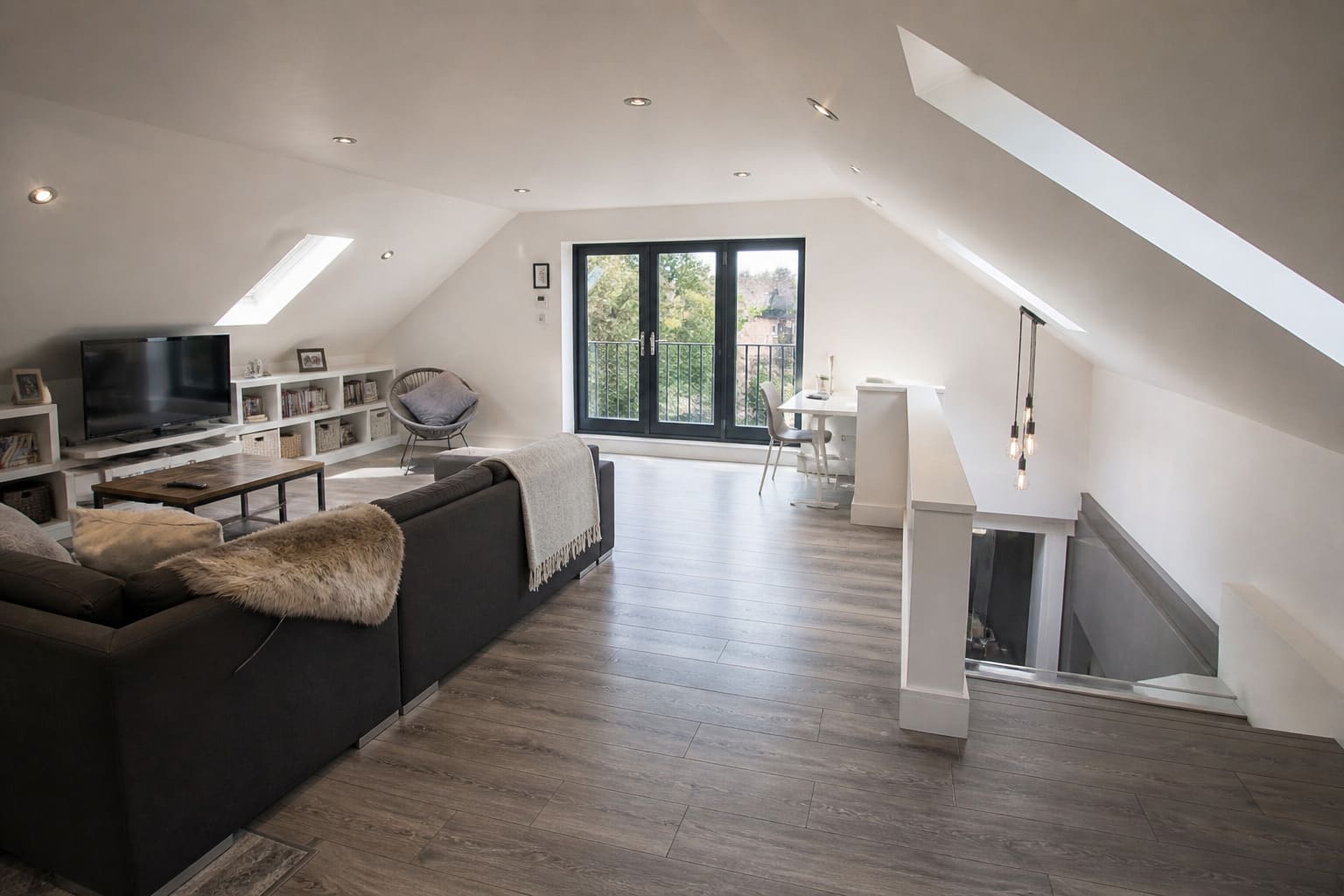
In practical terms, a compliant layout often looks like this: the new loft staircase rises above the existing stairs, the stairwell is enclosed from top to bottom, and the doors off the circulation route help protect that route. A layout that struggles is one where the loft opens onto a room instead of a landing, or where escape depends on passing through a kitchen or open-plan ground floor without suitable compensating measures.
Travel distance can also matter. If the route from the loft room to the final exit is awkward, indirect, or interrupted by open-plan alterations, local authority building control may question whether the means of escape still works as intended.
Some designs fail on first review because the staircase fits physically but the route does not function as a protected corridor. That distinction catches people out more often than the stair drawing itself.
Ensure your loft conversion meets all fire safety and building regulations before work begins. Schedule a detailed compliance review with our experts.
Book a ReviewWhat Fire Protection Measures Must Be Included by Law?
Escape is only one part of the picture. Fire regulations for lofts also require measures that slow down fire spread and protect the structure long enough for people to get out.
The legal essentials commonly include:
- Fire doors in the right locations, often on rooms opening onto the stair enclosure
- Interlinked smoke alarms, installed so that an alarm in one area alerts the whole house
- Fire-resisting walls, ceilings, and partitions that improve compartmentation
- Structural protection where new steel or timber elements need a suitable fire-resisting finish
Fire doors are not standard internal doors with heavier hinges. They are rated assemblies that must be fitted correctly, and some situations also require self-closing mechanisms, depending on the design and approval route.
Interconnected alarms are another non-negotiable feature. BS 5839 is often referred to for alarm arrangements in domestic settings, and building control inspectors will expect the system to suit the altered house, not just the loft room.
Compartmentation means dividing the home into sections that can resist fire for a set period. In a loft conversion, that can involve upgrading ceilings below, lining dormer cheeks correctly, and making sure service penetrations do not weaken fire separation.
Material choice follows the same logic. A finish may look neat on a drawing, yet the real question is whether the built assembly can achieve the required fire resistance under Approved Document B and relevant British Standards, including BS 476 where applicable to fire door testing and performance.
Involve building control early in the design process to address fire safety requirements before construction begins.
How Are Escape Windows and Alternative Exits Assessed?
A common scenario in London starts with a simple idea: if the loft has a large window, that can serve as the fire escape. Building control does not treat it that simply.
An escape window can be acceptable in some situations, particularly in certain lower storey rooms, but a loft conversion that creates a new upper level usually relies on a protected stairway instead. Once the home becomes three storeys, the main escape strategy is normally internal, not based on climbing out of a window. That is where many assumptions fall apart.
A compliant case might involve a window that meets egress standards in a room where that approach is actually permitted. A non-compliant case is a new loft bedroom in a London terrace where the staircase is left unprotected because the design assumes the rear dormer window solves the problem. If the window is too high above ground, hard to reach, or unrealistic for rescue access, it will not satisfy the requirement.
Where a window is part of the fire strategy, building control is likely to assess points such as:
- Minimum opening dimensions and clear openable area
- Sill height and whether a person can reach and use the opening safely
- External conditions below, including height above ground and access for fire services
Rear access matters here. A window over a narrow back addition, a conservatory roof, or a small enclosed yard may look acceptable on paper but fail once the external reality is considered.
London properties often sit in that awkward middle ground where a feature is technically possible to build but does not amount to a workable means of escape. That is why loft conversion alternative exits need checking against the whole house layout, not judged in isolation.
Carefully document original house features, as concealed voids and older alterations can complicate fire compartmentation plans.
What Role Do Professional Designers and Project Managers Play in Compliance?
Fire safety compliance in a London loft conversion is a design issue, a sequencing issue, and a coordination issue all at once.
An architectural designer may produce a staircase that works beautifully within a tight footprint. A building control officer may then raise concerns about the stairwell enclosure, the doors on the first floor, or the way an open-plan ground floor affects the protected route. Without joined-up planning, changes arrive late and cost more.
Project management matters because fire safety elements are spread across the whole job. The carpenter installs door sets, the electrician wires interconnected alarms, the plasterer helps maintain fire-resisting linings, and the steelwork may need encasement or another approved form of protection. Somebody has to keep those decisions aligned with the agreed fire safety design.
Early liaison with building control also reduces friction. Plans can be reviewed before the site is committed to the wrong arrangement, and awkward details can be resolved while they are still lines on paper. That process is one reason experienced firms, including Compact Building Ltd, tend to focus so heavily on planning and coordination before work accelerates on site.
Poorly managed projects often treat compliance as something to tidy up at the end. In reality, fire door positions, alarm locations, partition build-ups, and stair geometry all interact long before the finishing stage.
How Can Homeowners Prepare for Fire Safety Compliance Before Work Begins?
Preparation changes the quality of the whole project. A loft conversion rarely becomes easier to regularise once the layout is fixed.
Before plans settle, homeowners are usually best served by focusing on a few early checks:
- Gather accurate information about the existing house, including floor layouts, stair positions, and any earlier alterations.
- Review the escape route from loft to final exit, not just the new room itself.
- Raise open-plan ground floor changes early, because they often affect the protected stairway strategy.
- Ask whether pre-application advice or early building control input would clarify the likely compliance route.
- Read quotes and drawings closely for omissions around fire doors, alarms, and construction upgrades beyond the loft floor.
Original details matter because older London houses are often less straightforward than estate agent plans suggest. Ceiling build-ups, wall thickness, hidden voids, and previous refurbishments can all affect fire safety planning.
A careful plan review can also expose vague pricing. If a quote mentions the staircase and dormer but says little about smoke alarm requirements, fire compartmentation, or door upgrades on lower floors, the cost picture may be incomplete.
One idea is worth dropping early: compliance at the end is a myth. Once the staircase is in the wrong place or the hall is left too exposed, late corrections tend to be disruptive and expensive.
Get tailored advice on fire safety solutions and escape routes for your unique London property. Speak directly with our experienced design team.
Request ConsultationWhat Do Experienced Renovators Wish They’d Understood About Fire Safety from the Outset?
Many people start out thinking fire safety is a box to tick once the loft room design is finished. Experienced renovators tend to look back and realise the opposite was true. Fire safety was shaping the whole design from the first sketch, even when it was not obvious.
Some wish they had understood how often small early choices carry long consequences. A door position, a widened opening at ground floor level, or a slightly steeper stair can alter the approval path far more than an expensive finish ever will. Others say they assumed one accepted solution would fit every London house, then learned that regulatory nuance is part of the job, especially in terraces and period homes.
The quiet advantage is knowing that good fire safety planning rarely feels dramatic. Experienced people in this space wish they had known earlier that the smoothest loft conversions are usually the ones where the escape route, the structure, and the day-to-day design were resolved together, long before anyone started thinking about paint colours.